






As we head into Day ?? of social distancing, we find ourselves faced with plenty of options for keeping ourselves busy under this new normal. Some people are releasing their stories for fans to read for free, while others are finding self-isolation remarkably conducive to making progress on their blockbuster fantasy series. Still others are using their platforms for public health PSAs or taking the time to catch up their TBW lists.
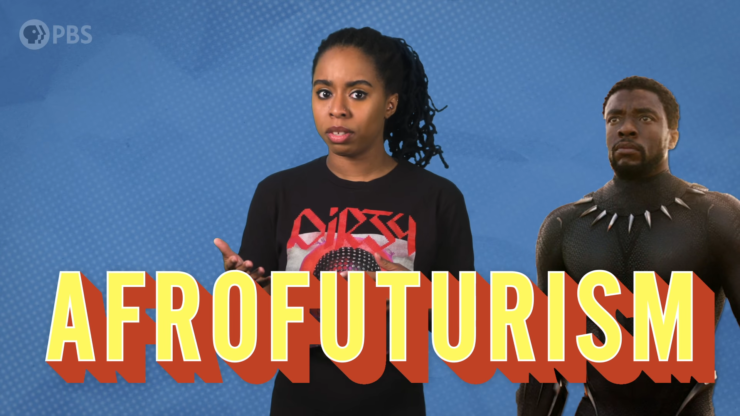
We submit another option: brushing up on your literary history. On this week’s episode of PBS’ It’s Lit!, co-host Princess Weekes is teaching viewers all about Afrofuturism.
Weekes begins by explaining that 2018 was a huge year for Afrofuturism. That was the year Black Panther, Tomi Adeyemi’s Children of Blood and Bone, and Janelle Monáe’s concept album Dirty Computer all came out, solidifying the movement’s entry into the mainstream.
“But Afrofuturism doesn’t just mean science fiction plus Africa; it’s a bit more nuanced than that,” she continues. “Afrofuturism addresses the cultural issues and concerns of the African diaspora through technoculture and science fiction, which is what Black Panther does. But you can’t just wrap a lightsaber in kente cloth and call it Afrofuturism (unless you’re John Boyega. He can do it). Afrofuturism, like rap, reggae, jazz, blues, and all the music that has come out of the black experience, is about creating art out of pain, strength, loss, and successes. It is fundamentally rooted in being denied a full history and looking to the future to correct that.”
From Mark Dery’s 1994 essay, “Black to the Future,” to the work of sociologist Alondra Nelson, to the books of Octavia E. Butler, N.K. Jemisin, Nnedi Okorafor, Rivers Solomon, and more, Weekes jumps backwards and forwards in time to give fans what is essentially an Afrofuturism 101 class in just under 10 minutes. Check out the video above!

Love this!!! Real quick though, Nnedi Okorafor doesn’t actually identify her work with Afrofuturism. Here’s a link to her blog post on the subject http://nnedi.blogspot.com/2019/10/africanfuturism-defined.html
Over the years I have really loved futures in SF were based on a different culture to the Western 1960s feel. Afro futurism isn’t that new to me but I find it delightfully engaging. Perhaps because a setting where it is the normality avoids the author banging their message into the reader’s head.
It’s not new of course and I really liked the high concept of the Polesotechnic League by Poul Anderson. Civilisation survived a nuclear war in South America. Move forward to a star spanning Latin culture. Although it still felt pretty American at times. Joan Vinge’s Snow Queen had a South Asian influence.
Black Panther did a great job I think. I realise there have to be compromises for an international audience. So when speaking English the African characters have a very educated voice. You see the same thing with Pria in Big Bang.
Anyway. Great article.
For those of you who have not yet read any or much African or Afrofuturism, I would get started. Who Fears Death, The Broken Earth Series and Tade Thompson’s Rosewater series, although Thompson does not explicitly identify with the Africanfuturism label, have been the an absolute joy to read. Such deep and interesting characters and character growth, with engaging plots which provide much to ponder on and dream along with. I have finished the first two books of Butler’s Patternist Series and am happy to have more Butler to read. Nicky Drayden’s YA book Temper is a great. I have The Children of Blood and Bone Series waiting to be read when I am finished with Butler. I would recommend Turnbull’s The Lesson too! I am always looking for more authors to read that identify with this movement and would love any recommendations.